
 レッスンを予約する
Step 1
Read the Article
Read the article to understand the main idea.
記事を読んで、おおよその内容をつかみましょう。
Ancient Roman faces come to life in Budapest exhibition
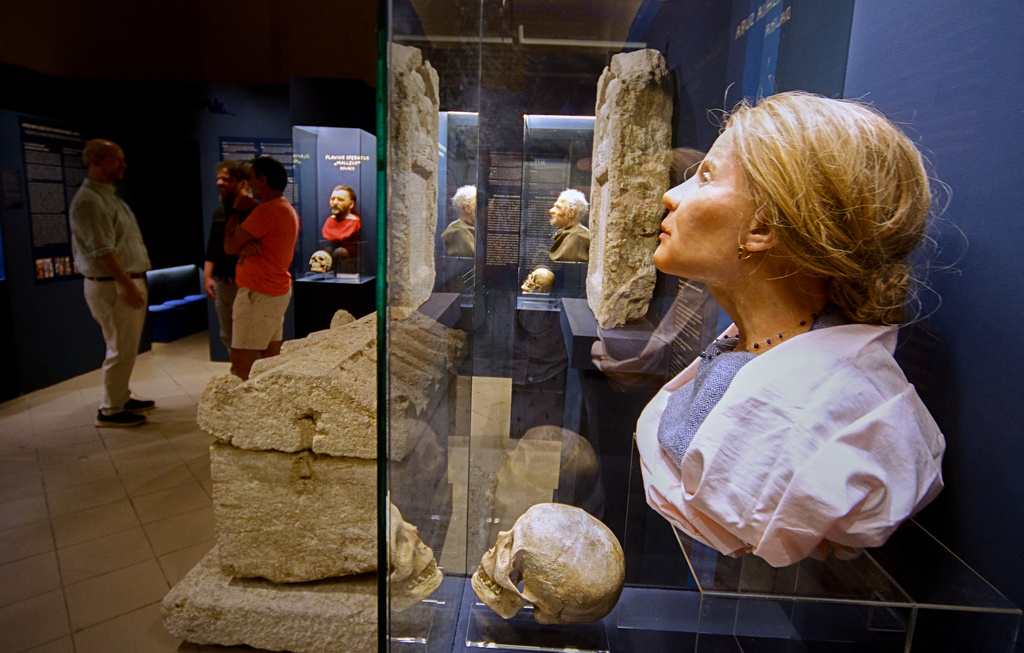
A new exhibition in Budapest, Hungary, shows facial reconstructions of people who lived in an ancient Roman city called Aquincum nearly 2,000 years ago. Called "Once we were like you," it runs at the Aquincum Museum until Oct. 31, 2026.
Experts studied DNA from more than a dozen skulls to learn each person's skin, hair, and eye color, and skull shape revealed facial structure, age, injuries, and disease. Curators then invented names, jobs, and life stories. Loránt Vass, an archaeologist and co-curator, said the team wanted to bring these residents closer to today's visitors.
One reconstruction shows a construction worker named Respectus, who plastered walls and cut stone in Aquincum. His nose was broken and a tooth knocked out in a tavern fight. Vass said most skulls showed signs of hard labor and hunger, suggesting most were part of Rome's lower middle class.
Of the 16 reconstructions, six are silicone models decorated with hair, clothing, and jewelry. Emese Gábor, who made them, said artificial intelligence can also create faces, but "they just appear on a screen," while hers can be viewed from every angle in a museum.
"They may have had different life conditions, different social status, but people are people," Vass said. "I don't think that has changed much across history."
(AP)
Step 2
Check the Vocabulary and Phrases
Check the following vocabulary and phrases.
以下の単語やフレーズの発音、意味、使い方を確認しましょう。
reconstruction
復元
a model or copy of something built to look exactly like the original, often to show what it looked like in the past
During our trip to Kyoto, we visited a reconstruction of a samurai house from 400 years ago.
京都旅行中、私たちは400年前の侍の家の復元を見学しました。
invent
考え出す、作り出す
to think up and create a name, story, or idea that does not really exist or is not exactly true
The children invented a funny name for their treehouse.
子どもたちは、自分たちのツリーハウスにおもしろい名前を考え出しました。
plaster
漆喰(しっくい)を塗る
to cover a wall or ceiling with a soft, wet mixture that becomes hard and smooth as it dries
My uncle plastered the walls of his new house last weekend.
叔父は先週末、新しい家の壁に漆喰を塗りました。
tavern
酒場
an old-fashioned word for a place where people can buy and drink alcohol, especially in the past or in stories
In the old town, there is a 200-year-old tavern where sailors used to drink.
旧市街には、かつて船乗りたちが酒を飲んでいた200年前の酒場があります。
hunger
空腹、飢え
the feeling of wanting or needing food
Hunger woke her up in the middle of the night.
夜中、彼女は空腹で目が覚めました。
Step 3
Comprehension Questions
Answer the following questions based on the article.
理解度問題に挑戦しましょう。
What method did experts use to find out the skin, hair, and eye color of Aquincum's ancient residents?
Why do curators believe most of the reconstructed residents belonged to the lower middle class of Roman society?
Step 4
Discussion
Share your opinions on the following questions.
以下の質問について、自分の考えを述べてみましょう。
Have you ever felt that you are connected to people from the past? Please explain your answer.
What do you imagine daily life was like for ordinary people almost 2,000 years ago?
If scientists could create a lifelike model of your face using your DNA, would you want to see it? Why or why not?
Do you think physical museum models are more interesting to look at than images created by AI? Why or why not?
If people in the future studied objects from your home, what job might they imagine you had?